Swarm Wave
Multi-Agent Task Scheduling with Swarm Intelligence
A comprehensive web application implementing bio-inspired optimization techniques (ACO & PSO) to solve complex resource allocation problems in distributed computing environments, featuring real-time visualization and interactive algorithm simulation.
Complex Multi-Agent Scheduling
Task scheduling in multi-agent environments is an NP-hard problem. Traditional heuristic methods struggle with large-scale scenarios involving multiple agents, task dependencies, and varying resource constraints. Finding optimal or near-optimal schedules requires intelligent optimization approaches.
Bio-Inspired Swarm Intelligence
Swarm Wave applies Ant Colony Optimization (ACO) and Particle Swarm Optimization (PSO) — two bio-inspired metaheuristics — to find near-optimal task schedules. With real-time SSE streaming, researchers can observe algorithm convergence and compare performance interactively.
Functional Requirements
| Code | Requirement | Description |
|---|---|---|
| FR-01 | Algorithm Simulation | Run ACO and PSO algorithms on selected datasets |
| FR-02 | Real-time Streaming | Stream algorithm iterations via Server-Sent Events (SSE) |
| FR-03 | Data Management | Import/Export tasks and agents via CSV and JSON files |
| FR-04 | Visual Analytics | Interactive Chart.js graphs for fitness progression |
| FR-05 | Parameter Tuning | Adjust heuristic parameters (alpha, beta, inertia, etc.) dynamically |
| FR-06 | Result Comparison | Compare makespan and execution times between algorithms |
| FR-07 | Interactive Table | Excel-like grid for manual task and agent modifications |
| FR-08 | Containerized Deployment | Docker-ready setup for reproducible research environments |
Swarm Intelligence Algorithms
Ant Colony Optimization
Inspired by ant foraging behavior. Artificial ants construct solutions by probabilistically selecting task-agent assignments based on pheromone trails and heuristic information. Pheromones are updated after each iteration, reinforcing good solutions and evaporating over time to avoid stagnation.
Particle Swarm Optimization
Inspired by bird flocking and fish schooling. Each particle represents a potential schedule, moving through the solution space by adjusting its velocity based on personal best (pbest) and global best (gbest) positions. The swarm collectively converges toward optimal solutions.
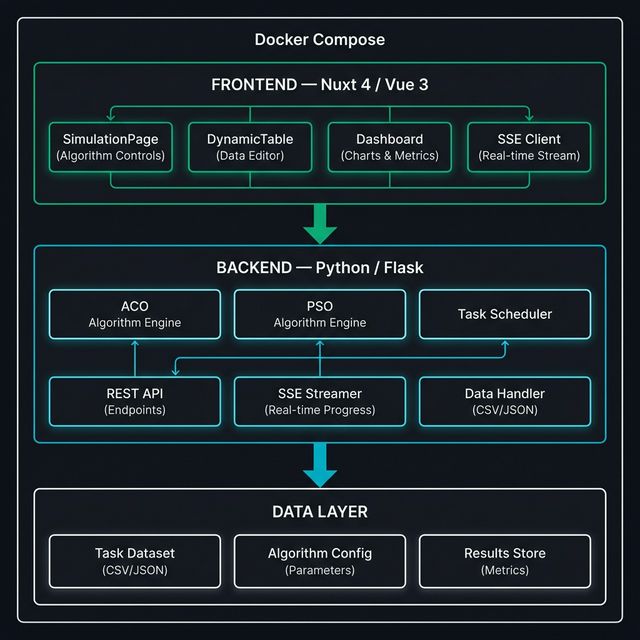
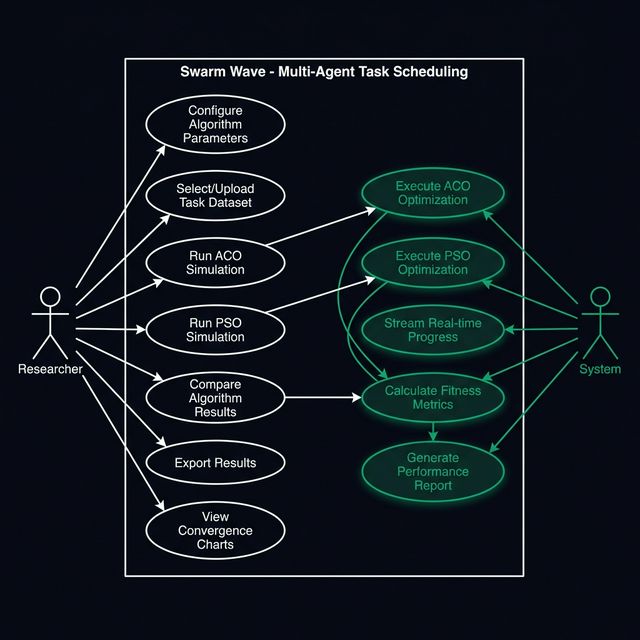
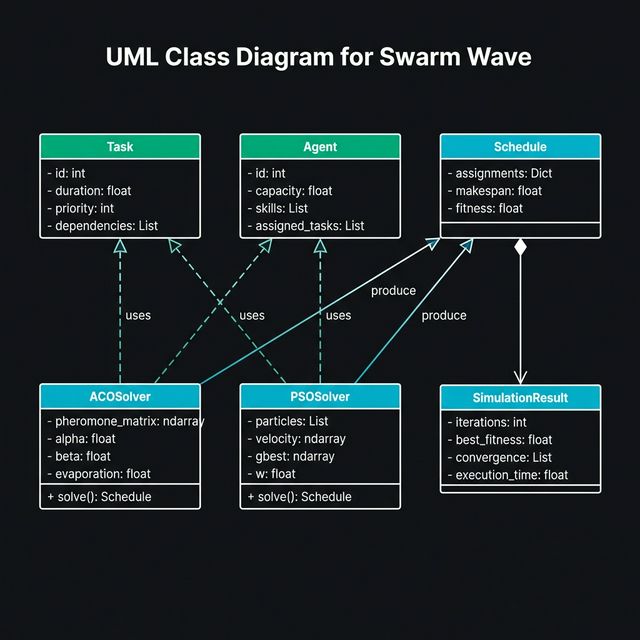
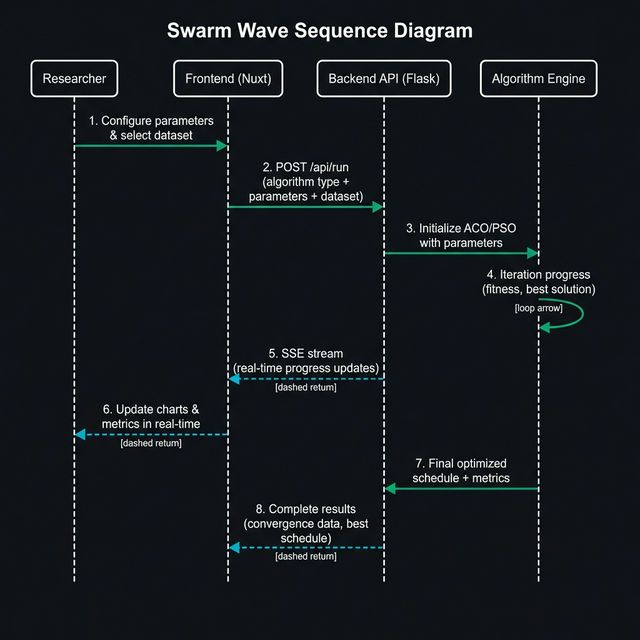
System Architecture
Use Case Diagram
Class Diagram
Sequence Diagram — Simulation Flow
Tech Stack
Key Features
Real-time Algorithm Streaming
Server-Sent EventsWatch algorithm convergence in real-time as iterations progress. SSE streams iteration data from the Flask backend to the Nuxt frontend, updating charts and metrics live.
Interactive Data Management
DynamicTable ComponentExcel-like table editor for creating, importing (CSV/JSON), and modifying task scheduling datasets. Researchers can customize task parameters before running simulations.
Performance Visualization
Chart.js DashboardsInteractive convergence charts, fitness progression graphs, and makespan comparisons. Visual analytics help researchers evaluate and compare ACO vs PSO performance.
Docker Containerization
Production ReadyFull Docker Compose setup for reproducible experiments. Single command deployment with isolated frontend and backend containers for consistent research environments.